
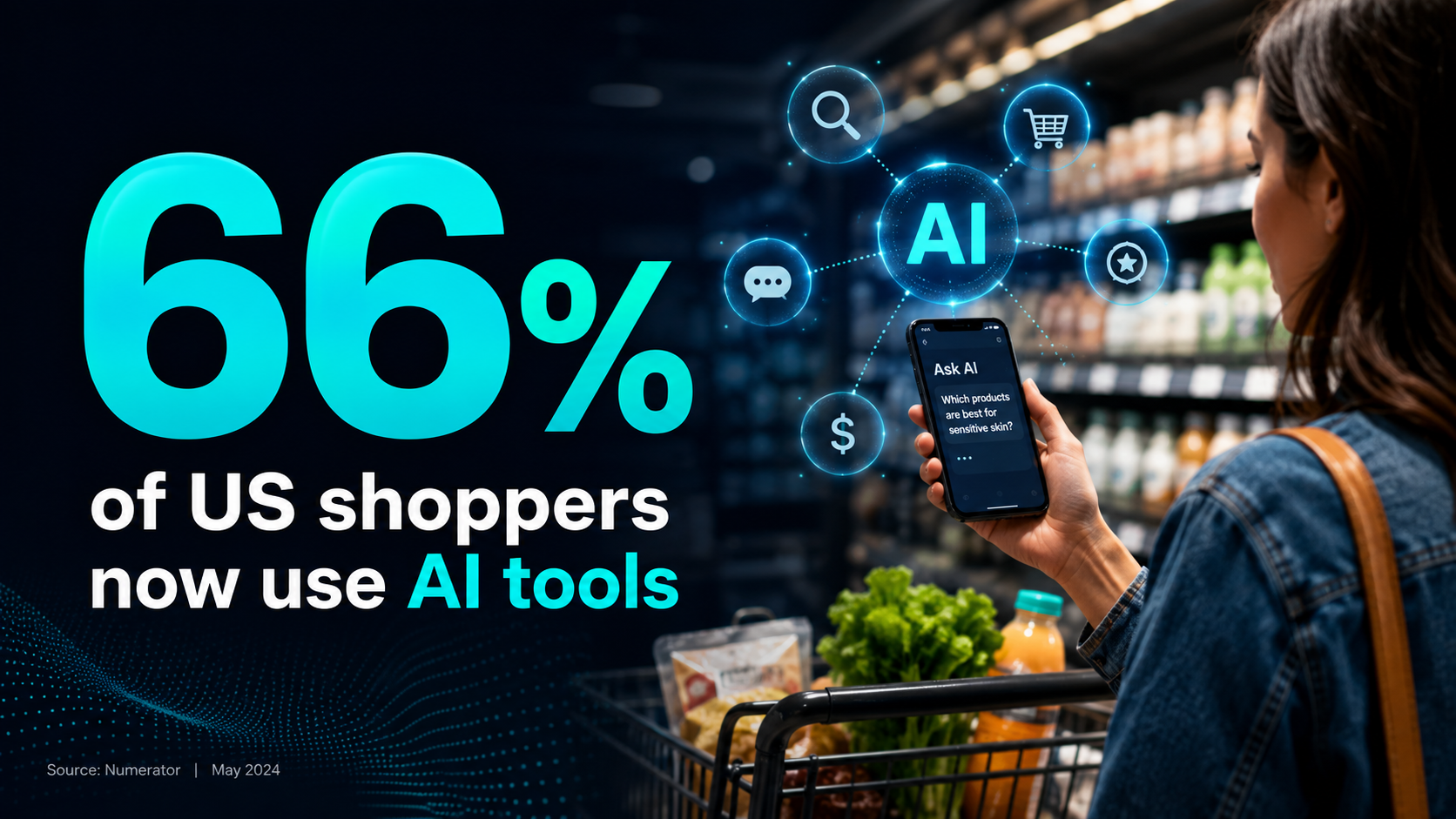
The last two features here tracked a preference flip and a visibility race: shoppers moving to AI tools, and CPG brands scrambling to be the answer those tools give. This week's evidence complicates that story in a useful way. Usage keeps climbing. But the emotional relationship shoppers have with AI shopping tools is souring, not warming — and the categories where that tension is sharpest are exactly the ones CPG brands compete in.
Adoption Climbed. Trust Didn't Follow.
Retail analyst Nikki Baird spent this week's Retail Pulse Report digging through four fresh consumer studies, and the pattern held across all of them: people are using AI to shop more than ever, and trusting it less than the adoption numbers would suggest. A 3,000-shopper study from Commerce and PayPal found 66% of US shoppers now use AI tools and 67% are interested in a fully autonomous shopping agent — but 82% say the security has to match or beat traditional payment methods before they'll hand over the keys. Asked who they'd trust to actually provide that agent, no single category broke a third: tech companies led at 34%, retailers and payment providers tied at 31%, and platform LLMs — the ChatGPTs and Geminis racing hardest to own this moment — came in dead last at 17%.
A companion Forbes piece the same week, drawing on Gartner research, put a sharper point on it: only 11% of US consumers are willing to let AI make purchase decisions even for low-stakes categories like personal care and household supplies, and 62% say AI shopping recommendations are a waste of time. Alter Agents CEO Rebecca Brooks called it a "trust recession." Liveops' Molly Moore, citing her firm's own research, put it more bluntly: shoppers "aren't rejecting AI so much as getting increasingly irritated with experiences that make more work for them."
Why This Lands Hardest on CPG
The categories where that irritation concentrates are not abstract. A Harris Poll report focused specifically on beauty and wellness, personal care, and household goods found shoppers are genuinely open to AI help — 72% are comfortable with it, as long as they keep final say, and majorities like it for comparing prices, checking product-claim accuracy, and summarizing reviews. The trouble starts at the edges of that comfort zone. 76% say they'd lose trust in a retailer whose AI recommended sponsored products without disclosing it, and 78% already assume brands are paying their way into the recommendations they're shown. Nearly three-quarters worry AI will narrow what they see rather than expand it.
That's the exact mechanism CPG brands need to sit with. The moment an AI assistant recommends a product without explaining why, shoppers don't read it as neutral — they read it as bought. Opacity, in a category built on claims and credibility, is punished harder than almost anywhere else in retail.
One Retailer's Answer: Own the Data, Own the Trust
Against that backdrop, Schnucks' move this week reads like a direct response. On August 12, the St. Louis grocer launched an agentic AI shopping assistant built with health-tech partner VitalityIP — grounded not in a general-purpose model but in more than six billion lines of the retailer's own shopping, health, and nutrition data, combined with live store inventory. Shoppers can hand it a budget and get back a shopping list or delivery order built around the week's actual deals, ask for recipes with in-store ingredient locations, or get nutrition guidance tuned to specific diets and allergies. It shipped alongside a redesigned interactive weekly ad that lets shoppers clip coupons and build carts straight from the sale page.
The strategic logic tracks with what Bain found earlier this year: shoppers say they trust a retailer's own on-site agent roughly three times more than a third-party one — accountability, not algorithm, is the trust lever, because a retailer has an ongoing relationship and a reputation to protect that a general-purpose assistant does not. Schnucks isn't renting visibility inside someone else's model. It's building a system shoppers can plausibly hold accountable, anchored in data no platform LLM has access to.
What This Means for CPG Brands
Three things follow from a week where adoption and trust moved in opposite directions. First, disclosure is no longer optional — with 78% of shoppers already assuming AI placements are paid for, brands and retail partners that don't label sponsored recommendations are spending down trust they'll need later. Second, generic platform visibility isn't the whole game; being present inside retailer-owned, first-party-data-anchored assistants — the kind shoppers say they trust three times more — is becoming its own distinct battle, separate from ranking well in ChatGPT or Gemini. Third, the burden of proof just went up. In a market where 62% of shoppers already call AI recommendations a waste of time, claims that can't be traced to a verifiable source — a certification, a clinical study, a retailer's own data — are the ones that get filtered out first.
The Bottom Line
Adoption was never going to be the whole story. This week made clear it isn't even the hard part anymore. Shoppers are already using AI to shop — the surveys agree on that much. What they haven't decided is whether to believe what it tells them, and in personal care and household categories, they're leaning toward no. The brands that win the next phase of agentic commerce won't just be the ones AI recommends. They'll be the ones shoppers believe when it does.
Sources: Nikki Baird, "Retail Pulse Report: Consumer Discontent with the AI Future Is Growing," Aug 10, 2026, citing the Commerce/PayPal Agentic AI Shopping Research report (fielded March–April 2026) and The Harris Poll's CPG Thought Leadership Report (published June 2026); Sharon Edelson, "Why Consumers Are Frustrated With AI and What Retailers Can Do About It," Forbes, Aug 5, 2026; Progressive Grocer on Schnucks' agentic AI assistant with VitalityIP, Aug 12, 2026; Bain & Company, "Agentic AI in Retail: How Autonomous Shopping Is Redefining the Customer Journey," May 14, 2026.